Saturday, December 18, 2010

The Greatest American Shirt (made anywhere in the world)


A surprising number of emails come to me asking about shirt patterns. At many of the large accounting/consulting firms, only white dress shirts were permitted (this has largely been relaxed since 2000 or so), making pattern and color nearly criminal... a restriction that is more offensive than the assumption of offense of wearing pattern. Imagine a large multi-floored office, staffed by private citizens, all told that only white dress shirts with barrel cuffs will be permitted as a condition of working there. The advice they provide-for-fee better have an accuracy rate in the 80% range to make that nonsense tolerable.


Readers often ask what pattern is the best. In America, the most conservative pattern is our beloved Bengal stripe in navy or lighter blue.


This is a staple pattern in which all men should own at least one shirt. It can be worn with nearly anything, and besides white, it is the most versatile and lasting shirt pattern that we have at our disposal. While there are slight variations in blues, widths, etc., it is one of our finest.


Jeans, khakis, shorts, flannels, suits, corduroys, sweaters, and with nearly any tie, the navy Bengal stripe is universal to the point of being almost overlooked by the eye. It is great as a soft button-down collar, a casual faded oxford, a cut-away collared french-cuff, a barrel-cuffed pointed collar, and even as a white collar/white cuff version, the universal appeal of this shirt is obvious. While it is traditionally not uniquely American by any means, it has become a staple of Americanism, generally accepted in nearly every application.
Unbeatable with a navy blazer, conservative with a suit (even a 3-piece), great under a rugby shirt or over a solid polo shirt, and ubiquitous with white pants and Sperry Top-Siders in summer, this shirt can withstand any pattern of tie, bow tie, ascot, and in any color.


If there is a truly American shirt pattern, this is sure to be it. Perhaps there are others that carry more historical importance, but this pattern, in ANY cut, is (beyond plain white) the single most versatile yardage of fabric at a man's disposal when assembling a wardrobe. If one had to have two shirts only, they would be a single white one and a single navy Bengal stripe.
When I see them on sale at LL Bean in wrinkle-free, I get them. When I saw them at TM Lewin (slim-fit St. James Collar) online for $30 each, I ordered several. When they get too worn out, they become short-sleeved beach shirts, painting smocks, handkerchiefs, etc. And when I travel for business or pleasure, they are first into the suitcase. Even the tattersall and pinstripe shirts are out-paced by the Bengal stripe, restricted by no season, and welcome with more assemblies than any other pattern. If Americans can lay claim to a single shirt, this may well be ours.

Friday, December 10, 2010

Reader Questions

Dear Yankee Whisky Papa,
I am an admirer of your column Boxing the Compass. All of your sartorial advice is greatly appreciated, but I wonder what your thoughts are on another issue that is pertinent to men and style. I speak of the frequently ignored issue of mens cologne. Quite obviously, a man can undo all of his otherwise noble efforts in dress by improperly--either in amount, method, or type--applying a fragrance. I wonder if you could please speak to the following questions:

1. Is it appropriate or even desirable for men to wear fragrance?

2. If it is appropriate, which specific fragrances are acceptable, and what is the best method of application?

3. Please address the relative merits of cologne vs. aftershave.


Cordially,
A Co-ed in New Haven

-------------------------------

Dear New Haven Co-ed,
For millennia, we men have offended the noses of the more pleasantly fragranced. Either wrapped in stinking fur hides in a flame-lit cave or standing watch on a square-rigged floating disease incubator wearing a festering neck-cloth, we have historically not smelled good. Fragrances were always a masking agent for men, a way to quickly clean up, and to attempt to make closeness with another human tolerable, despite the putridity we effortlessly emit. Fragrance in our past was critical, possibly the main factor allowing humans to tolerate one another long enough to allow reproductive mechanisms to complete themselves.
The truth is, today American culture generally finds us showered daily, and in reasonably clean clothing (thanks to laundry machines, etc.). Fragrance is no longer crucial, and is instead now merely a pleasant option. Today, men wear fragrances for one of several reasons:

1. They stink
2. They think women will find it and the wearer attractive
3. They wish to establish a trademark scent
4. All of the above

As far as it being desirable and appropriate, the answer is in the nose of the beholder. Some fragrances have an innately pleasant smell, and others recall memories (in any direction) of their associations with that smell. Olfactory memory triggers are frighteningly instantaneous and accurate, and you may be flashed back to an 8th grade slow dance when you catch a whiff of Polo on the subway. Men also risk having the association be unfavorable for the recipient, as we all have experienced at one time or another. As I left for college, Father told me not to pick out my own cologne, unless I wanted to pick up other men... advice that translates beautifully into so many other areas.

How to apply fragrance
Great Uncle once told me that a man's fragrance should only be detected by a lady when sharing a dance or a secret. Damn fine advice.

This means applying it with a Q-Tip or the tip of a finger somewhere in the mandible/ear lobe/neck area, in the tiniest possible amount. Again, the tiniest possible amount. As for which particular scent to choose, I believe that this is an age-old dilemma, the solution for which is somewhere in the trial-and-error laboratory of one's dressing area/night out. Men also should fully confront the possibility that NO scent may be their best option, and these decisions should be approached with brutal honesty between woo-er (scent wearer) and woo-ees.

The third part of your question (cologne vs. aftershave) is also important. Aftershave is a cooling/antiseptic/soothing liquid with fragrance ranging from subtle to over-powering, applied to a freshly-scraped face. Like shining one's shoes, sometimes a nice aftershave can give you a lift in the morning, and I find them particularly nice in the summer. I only occasionally use aftershave though, and when I do, it's Clubman.


The scent is pleasant and not all-consuming, and unlike cologne, [aftershave in general] looses its potency relatively quickly. Aftershave is dashed into the palm in the same quantity as bitters into a Manhattan -one or two will do the trick- rubbed together, and clapped onto the newly de-whiskered face. If you prefer to go Old school, witch hazel also makes a nice aftershave, and it will straighten up your spine when it goes on for the first time. A small bottle from the drug store will cost under $3.

We have all experienced the nauseating and imposing sensation of someone wearing far too much fragrance, and for those of us with acute senses of smell, it can be very uncomfortable. My final advice is DO NOT COMBINE. If you choose to wear cologne (I never do), do not use aftershave, and only use a scentless deodorant.

I hope that this answers your question.

Wednesday, December 8, 2010

Reviving Shirts II

For those who recall the post about restoring worn out shirts, I took several more shirts to the Wellesley shirt maker (Custom Clothiers) to replace the worn out collars and cuffs.

Harry was happy to provide replacement therapy, and I was quickly talked into transitioning the shirts from conservative (business-acceptable) to a more social configuration.

The first was a nice Thomas Pink number I've had for a LONG time. I chose "lilac gingham" (as TM Lewin says) and with a tab collar. French cuffs replaced the barrel cuffs, and the result was interesting.


The next was a small butcher-check in black and white from Brooks Brothers that I bought on clearance about 10 years ago. It got the exact same treatment, again switching barrels for thick French cuffs. Since I never wear these shirts without a jacket, I could allow a thicker and sturdier cuff.


The tabs close nicely with tiny buttons, and the contrast is fascinating to some and offensive to others. Success.


Like all good tab collars, they lift the tie just so, creating an illusion that the collar stands higher and more formally than it actually does.


Have a shirt ruined with ink or rips in the body? If the collars and cuffs are alright, consider saving them and scrapping the rest of the shirt. There is a good chance that your local seamster/seamstress can attach them elsewhere, or if you are good with very small stitching, it seems a great way to cobble together a great salvage job. If you try this, please feel free to send in your photos, and I will post them in a future feature.

Velvet Slippers


Winter brings snow. Snow brings boots. Boots bring messes into hosting houses. Leave your boots and thick winternalia at the door, in the mudroom, by the coat rack, or in the foyer. Slip into your velvet slippers or shined smooth-sole mocs, and enjoy the festivities. An evening suit, black-tie, sweater/jeans, or jacket/tie combination will always be enhanced by Albert house shoe. I picked up a pair of Stubbs & Wootton in brown with a flyfishing scene that, as Dearest Grandfather pointed out, when placed side-by-side, clearly depicts a rainbow trout who has snagged the fly line under a submerged branch. Just my luck.

For black-tie and evenings, the Berk fox heads are great, and their quilted red lining make them soft and warm.

A few years ago I purchased some of Del Toro's embroidered pheasant slippers, and they have held up very well. Del Toro has relocated their production to Spain, and the already fine quality has improved even more, though they are still of the least expensive on the market.


I also found a pair of very inexpensive (dark red) velvet slippers online, that are much thinner, but still do the trick.

Velvet slippers always make great gifts, and while they can be pricey ($125 and up), they will last and be loved... landmark or milestone birthdays, anniversaries, etc. On top of it all, they make good slippers too for pajamas and robe. Be warned about their smooth leather soles, though. When combined with carpeted stairs and an abundance of brandy, phrases like "take time to slow down in life" take on new meaning.

Monday, December 6, 2010

Winter Hats and Decisions During the Cold

Men in the Northeast tend to do one of two things concerning their scalps and ears on very cold winter days: nothing or barely something... similar to what they do when it rains.

Further north (Maine to the Dakotas and upward), men have a bit more sense concerning the cold and their heads. I have a theory that each person has "their temperature" on either end of the thermometer. These are the points below or above which all care about style and presentation abruptly end. For me, about -10 Fahrenheit trots out the "snow ninja/nuclear refugee" look, while my wife's thermostat engages at anything below 40. All of this aside, the question remains: How does a man dress in harsh winter, concerning his head?

It seems that in the US, we are very bad at wearing hats (this generation), so one should first look to the cold weather hats sanctioned by uniforms. The US Coast Guard Academy, the US Post Office, Police Departments, etc., all prefer the aviator-style hat with fur or wool in/suede or leather side out. Obviously, a relatively plain dark colored watch cap is always safe in cold, but if you have to be seen outside in these low temperatures (parades, dedication ceremonies, caroling, etc.) and you are required to dress, a better hat is called for. Fur.
If fur is not appealing, one can go synthetic if you dare, or try out lambs wool in one of the shapes ranging from envelope to stove-pipe.
The Russian "ushanka" (ear hat) is also a prized winter option, and I'm seeing more of them around various financial districts. Be sure that you remove all medals, badges, insignia, etc., or you'll look like a fool and will be the recipient of Red-baiting from the old-timers. President George H. W. Bush wore one during the painfully cold inauguration of President Obama, rocking a purple scarf and wool turtleneck... no tie.

Here, President Ford still looks patriotic wearing his.

The ear-flaps on the ushanka do not need to be deployed to be warm. If they fasten atop, simply loosen the ties and lower the fold to cover half of your ears, and it is remarkably warm. If it gets too cold, and you drop the flaps fully, you will be warm beyond belief, but won't hear a thing.

Less dress options include the hunting style hats such as my favorite wet/cold duck hunter ("Jones Style") from LL Bean:
What you don't see are the fleece ear-flaps/half-band that fold down for insane warmth. Drop the back brim down (if your collar is high) and it's fantastic in hard rain. It is warmly lined, and I cut off the tag you see in the picture. $40 or so, but with a lifetime warranty as usual per LL Bean. They also offer a gray wool one (dressier?) for under $30.

I'm not sure why men have such strained and dysfunctional relationships with hats, either adopting a single one as their "trademark", wearing them indoors, at a table, reversed, or just not wearing one when they are needed (sun, snow, etc.). I don't want this to sound like a retro-nostalgic plea for all men to start wearing hats again at all times, but the abstinence and hard-line approach to hat policy is childish.

Friday, December 3, 2010

Creeping Cuff Style

This posting is to decry the current trend of tight high-water pants. It seems to be the approach for 20-30 year-olds being dressed by someone else for the purpose of magazine or catalog photography, converting otherwise very nice materials and patterns into a near-ruined set of clothing.

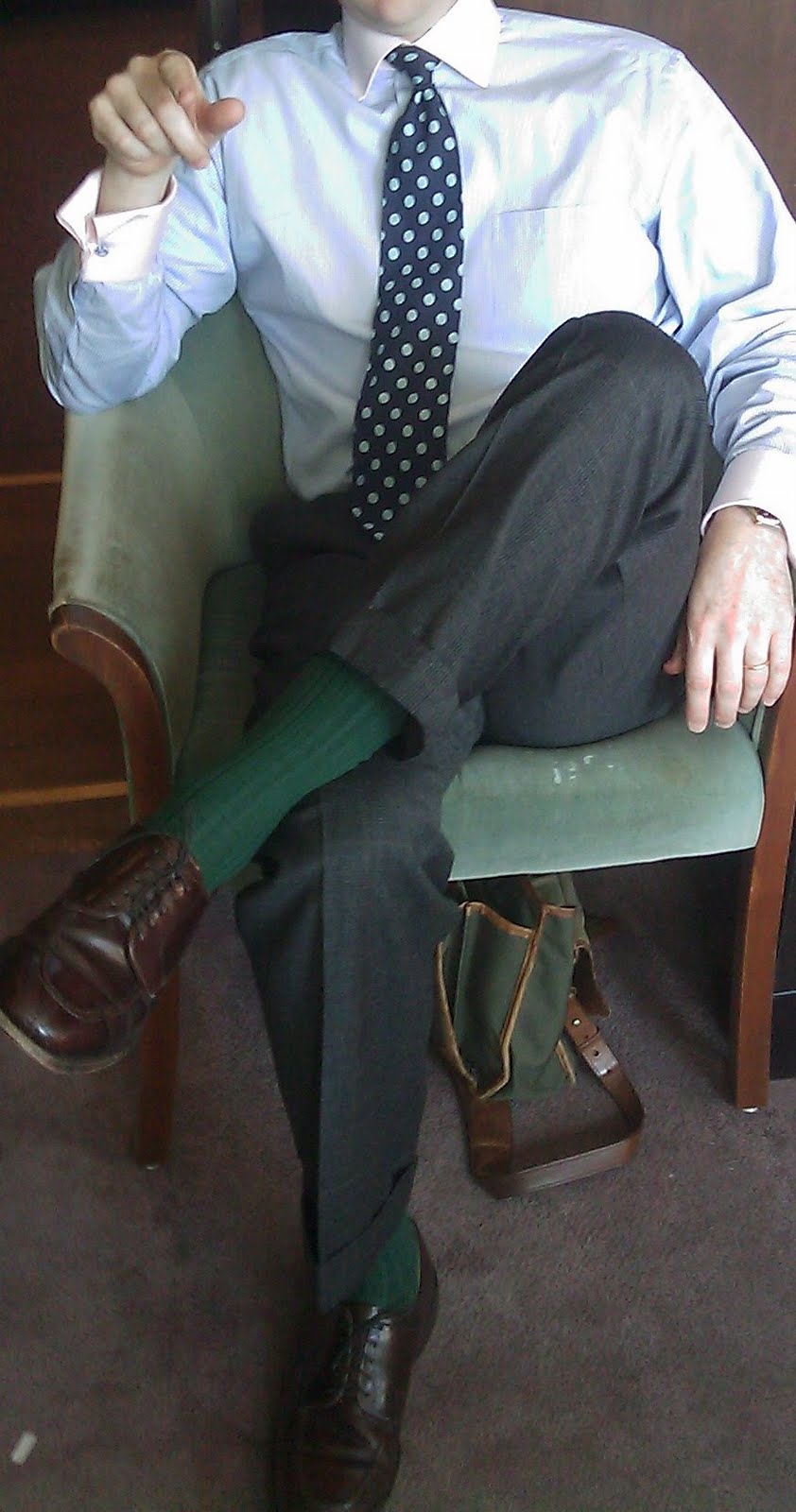
If you can see the sock beyond the occasional flash, the cuff or pant leg is far too short.

A high-water pant leg can be acceptable, but there should be room throughout the pant, not tight AND short. Socklessness with dress lace-ups is a bad move (Topsiders are one of the several obvious exceptions), and summer/early autumn (VERY early autumn) are the times for it.

What is barely passable in a photograph can be disastrous in the flesh/cloth. Tight pants on men should be restricted to wet-suits and other athletic applications.
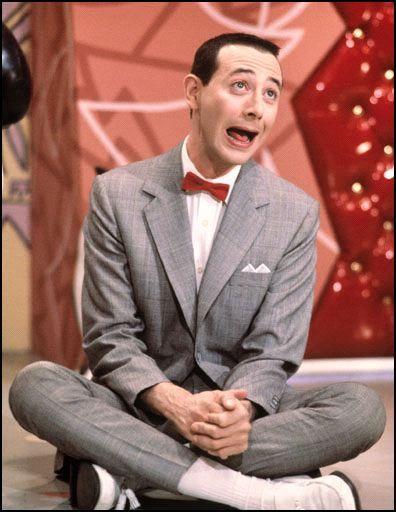
Paul Rubens and other similar-schticked dressers could not have imagined that their parody would become emulated in earnest by those applying their brand of rough-tuning to areas generally off-limits as dictated by the human eye.

The faux-growth spurt look is odd, and is thankfully temporary. If the shortened look hits the wrists, I'll lose all hope. Style and fashion are two different things. Fashion takes style and tunes it, alters it, and repackages it into something that may or may not nod to the original. When "preppy" and "WASP[y]"* became the launching point for a particular fashion trend, it was inevitable that the mark was missed on many points. Observers emulated the color, patterns, materials, and combinations of the look, wrote examinations of the manners and attitudes, and analyzed and documented the customs. While many were VERY observant in their writings, most failed to note that which was NOT done. These young men are shocked and indignant when they are told that while their tweed jacket and club tie are nice, their jeans and sockless ankles will not allow them to remain at the Club (though they are generally allowed to finish their drink, if their host got them that far).


 *Stop trotting out these terms so liberally.

Wednesday, November 3, 2010

Uniforms


I thought immediately of Paul Fussell 's book Uniforms (2002)
It's a strangely captivating picture, the details of which are unknown to me. The internet seems to think it is a Chilean Female Military or Police column.

Adding Fuel to the Fire

After last winter's firewood posting, I received a touching email from a reader, transcribed in its original, below:

"i only come here to read about mans cloths and not stupid fire wood pictures wtf pls dont post this stupid stuff again thx."


From what I can gather of the reader's carefully composed request, more pictures of firewood are needed from this blog.

Autumn and winter in Boston always bring the smell of fireplaces to the strolling nose. If the supplier's truck is not seen out front at various Boston houses, one can sometimes see small trails of bark and sawdust on the short delivery path from truck bed to front door or courtyard before they are swept up. The old families will carefully put these sweepings in a small metal bin to also be burned. Many use dogs as the cover for walking home with several sticks from the Common, sticks that are certain to be used in fireplaces, dogs that are certain to lay by the hearth.


Untrunk your wool, switch the screens for storm windows, and Happy autumn.

Monday, November 1, 2010

Bow ties

The poor bow tie. It's maligned, misused, punch-lined, and neglected on a daily basis. While it was beloved on young boys through the 50's and 60's, the 80's used it as a prop in movies and television, and in the 90's, you only wore a bow tie if you were getting married or if your driver's license said Louis Farrakhan or Tucker Carlson.


The bow tie also seemed to (unfairly) have stylistic restrictions on it:

professor, curator, or pseudo academic=yes

politician, broker, executive=no

The bow tie would become (and stay as) a prop to denote studiousness, detail, intellectualism, or a safely dosed strategical deployment of non-convention. It allowed the wearer to get credit for daring or deviance without the actual breaking of rules or custom to a degree that would motivate a boss or client to require correction. One can hardly imagine a club, restaurant, or function stopping a hopeful attendee at the door, saying "I'm sorry sir, but bow ties are not allowed."

I generally follow some internal do's and don't's about the bow tie, but they are subtle. For instance, I feel that they are generally acceptable with all suits (including 3-piece), jacket-and-tie configurations, and with sweaters (including cardigans, vests, and yes, crew-necks). The first image below is from the very likable blog An Affordable Wardrobe


They also look intimidatingly fantastic with pinstripe suits and white-collared shirts.


The biggest danger of the bow tie, is wearing it too often. One approaches schtick if it becomes one's thing to wear a bow tie. Once they become a fixture around your neck, you've restricted yourself. Like most things in men's clothing, variation and variety are enriching, and a de facto trademark will diminish the potency of the style itself.

There are plenty of shapes and styles from which to choose. Straight with flat ends and those with pointed ends are more difficult to find.


One problem with bow ties is that the majority of them are adjustable. While this seems like a good thing, the adjustment device is often a terribly unstable mechanism to deal with, and if you're wearing black-tie with a winged collar, the adjuster is on full display, contrasted sharply against the white shirt.
If you know a good tailor or seamster/seamstress, you can have bow ties made for you pretty easily, all in one long piece of silk, and with the shape and ends that you like. I was also given several bow ties that had the middle length (ostensibly an adjuster) removed and replaced with a sturdy and handsome ribbon, leaving 5 or 6 inches of the visible body on either end untouched. Very clever.

One element of the bow tie is that unlike a long tie, it cannot be loosened up during long humid summer strolls... it's either on or off. This tends to be a secretly loved characteristic that bow tie wearers quietly appreciate: commitment to wearing it. The toughest bow tie wearer I ever saw was in a humid piano bar in Zurich during summer. A menacing ox-muscled Alper of a waiter with snug white shirt sleeves rolled well above the elbow insisted that I clap with more enthusiasm to a Billy Joel cover as he refused my 10% tip as too lavish.

The bow tie and long tie are almost always interchangeable, but they are not the same. While a bow tie is rarely incorrect, there are certainly times when one or the other is slightly more desirable to achieve a particular effect or nuance. A judge in a bow tie will be perceived as technically and procedurally minded, not subject to swaying by wild or daring legal arguments. Antiques appraisers, doctors, and accountants are well-served to wear bow ties, as it instills (unfairly) confidence in their ability by the client or patron.

For my toddler son, I often use small pieces of spotted or patterned cloth ribbon for a nice disposable bow tie. Lastly, no pre-tied bow ties. They look terrible, even on children.

Monday, July 12, 2010

Bad Collar during a Collar


A reader sent me this mugshot of actor Wesley Snipes, who was collared and charged with tax-related wrong-doings, mostly involving maneuvers evasive. My entry on collars (Primary Collars - Nov. 8, 2009) showed some examples, but here we have one actually worn.

Where the collar should stop, it continues, and in the direction it should not. Had the original cut angle of the second tier been the template for the top, we might have something. How odd. The mens' collar does not need reinvention, it needs rejuvenation. As for Mr. Snipes, throw the book at him, but make it one of Alan Flusser's.

Friday, June 25, 2010

Presidential Collars

Watching the World Cup on a business trip to Little Rock, Arkansas had me double-take when I saw what my host-city's famous son wore while he was in South Africa rooting for the US men. President Clinton's collar forced me to post a few images of it.
There stood our former President, in an uncharacteristically excellent shirt of purple "gingham-check" (we often call it a small butcher check), with a fantastic cut-away collar. This looks a lot like a T.M. Lewin St. James collar (they call it "lilac"). Judging by the photo above, it may not be of the tapered variety.

Appearing at the World Cup in so pleasant a shirt, with a tie equally well played was impressive. Discovering this while I was actually in Little Rock was all too strange, and I was immediately moved to broadcast his handsome choice in collar. This also means that I have to either partially retract, or at least modify, my earlier claims about Pols and collars. Well played, Mr. President.

Monday, June 7, 2010

Socks the life out of you...

The rebirth of the sock seems to be here. Several readers have asked about socks lately, so I am putting this in. What do socks mean? Generally, something beyond keeping chiggers off the ankle bone, but not as far as a semaphore code of the clubby cognoscenti. Purveyors of fine gent-clothing are filling their sock display cases with vivid and relatively heroic sock patterns, to the delight of many, and to the horror of most. The preceding-described ratio gives the trend a better-than-average chance of being good, but with a shelf-life (drawer life?). Is this a trend? Yes. Is it new? Absolutely not. The English pioneered the gentleman's ankle-hose chance glance as a template for dash just as the neck, breast-pocket, and wrist were all developed into fully legitimate and explorable areas of statement.


Conservative suit? The socks take the sting out... or perhaps add it in... either way, you transform the look. Do you regularly meet after work in a venue surrounded by men with the off-the-rack-cut suits? Have the lawyers or fancies begun to add the pocket-square after several of your handsomely bedecked appearances? Simply steady the helm right for the rocky shore, and watch the others peel away to safety as your spreaders brush the branches on your daring tack, in and out of territory unfriendly to most.

BTC Contributor at the Speakeasy
Double breasted suit or blazer? Why not deliver that Lord Byron lecture in ribbed pink socks? The timid will gasp, and the ladies will cross the room to compliment you.

If bold stripes are too flash, soften the ankle/shin reveal with a more plain green, blue, or maroon.

YWP in Green Socks
If you see a man in a conservative suit wearing red socks, there is a very good chance that he is involved in the London arts scene, and is familiar with where one gets genuine lacquered pieces at fair prices. Mismatched socks? Probably a good writer or a bad graduate student. White socks? This one depends: If they are tube socks, you are interviewing an impostor, and you are about to be shaken down for what money you can pull together from pockets and wallets.


If the socks are thick and heavily cabled, and can be pulled over the knee, you have a man wearing kilt-hose with his suit during the winter, and you should treat him like the visionary he is. Make no mistake... tall ribbed black socks are perfect, and always acceptable. Gold Toe makes great ones that last forever, and have nice ribbing and snap. The best? For my money, and for universality, I like tall ribbed over-the-calf charcoal flecked socks. However, the trend back toward ankle-flash is welcome, and I hope it continues. Thomas Pink, Turnbull & Asser, T.M. Lewin, and the rest, all have vast new inventories of more daring socks.

I am happy to see these little ankle beacons flickering around sidewalks, halls, and offices. I like it with black-tie on occasion, and one can't go wrong with thinner models worn with summer suits. If you are expected as a guest at a house or culture which generally requires shoe-removal at entry, show the host that you don't screw around, and reveal polka dots ("spots" to the English) or a candy-stripe from within the shoe which they assume with defile their floors. The perfect time to try out a particularly loud pattern is during air-travel... TSA and the white-sneakered air patrons will get an eyefull as you remove (for inspection) the hardest working element of your wardrobe.

Sunday, November 8, 2009

Matters of the Hearth

As late autumn is here, I took delivery of some firewood for the cold, drafty city house. I buy the wood from a man in-state, who maneuvers his truck down my street here in the old section of the city. Once at our door, we throw the wood into the courtyard garden, I pay him, he drives off, and I spend the next hour or two stacking the wood. I have endured endless lectures from older family members about the proper ways to stack firewood, and have split more cords of wood with a maul than I can remember... all of which I think fondly. Because the courtyard is small, and I took a full cord of hardwood (white and black birch, cherry, and hickory), I wanted to stack it well and efficiently. Traditional log racks only hold about 50 or so logs, and do not do the trick for me. I knew that a cross-stack or two would come into the picture, and since I would be using a brick wall as the back and as one end, I could pile the rest between the wall and a tall-but-steady cross-stack. Out of curiosity, I checked online for some creative stacking photos, and found the following.
Stunning. The axe (not splitting maul) in the stump completes the sculpture, as if it were just felled. Below, haystack-style piles are still impressive.

In France, a house with a large over-hanging roof creates a nice shelter for the firewood, against the house walls. Notice the temporary boxes around the windows. The picture below shows a very tight and efficient cross-stack, though if you have children, they must stay out of the tempting labyrinth of stacks.
A smaller version of the felled tree sculpture:
In the end, I realized that my son might try to climb the stack, so I put in some flying buttresses of wood stacks to hold the thing against the brick, and worked in a few courses of small rounds. A few years ago, I took delivery of all unsplit birch, and spent the winter swinging the maul myself, but the neighbors made it clear that the "hobby" was unsuitable for the city. As I write this, a birch fire roars, the Brandy tastes wonderful, the slippers are comfortable, and the wood is safely stacked outside, and yes Father, the wood is stacked bark-side up.

http://en.wikipedia.org/wiki/Splitting_maul

Primary Collars

I had thought about making this an extensive post, as there is limitless non-sense of which I am capable. I was in the airport recently, and came to a realization about the collar. It's really all you have. Cuffs peak out from the jacket sleeve from time to time, usually during fabricated descriptions of various measurements or when being sworn in at one's indictment proceedings... but the collar is what is seen of the shirt when one is dressed well. It really is just a few square inches, and that's all you have. In America, we give it woefully poor treatment and afterthought at most, preferring to leave the decision to shirtmakers who do the same. I will not spend much time on the button-down collar, and let me say that it is far less formal than the rest, but there is nothing wrong with it, so long as it is used appropriately. I won't make this a thorough examination, either, but will instead give the bare essentials of how to think about it and approach it.

Cut it out, cut it away, spread it it out.

The Europeans have shown that the old "your collar shape should depend on your face" thing is not as firm as you might suspect. After speaking with almost a hundred shirtmakers, I have come to the conclusion that unless the collar is buttoned down, it should, at a minimum, be spread. I would call a spread collar anything that produces a collar gap of 90 degrees to a little more. Beyond that, I would call the others cut-away. Politicians prefer the formless collars, in pointy, floppy, plain form.

Here, our President wears the same collar that all pols seem to be required to wear. I hear about all of these guys having "tailors", but their boxy toga-suits and generic ties and collars suggest that several people are laughing, though for different reasons.

A spread collar is the bare-minimum, as far as the eye is concerned. Below, the angle pleases the eye, and adds a level of can't-put-your-finger-on-it elegance.

As the collar spreads further, the interest increases.

When it starts to go around to the back of the neck, we must proceed with caution. The extreme cut-aways are attention-getting, and people will certainly be able to put their fingers on it. They look great with coat and tie, but are a bit too steep for many business settings. As far as wearing them socially though... they are unbeatable.
A certain friend of mine (who chairs a certain committee, at a certain club) had appeared in a collar that shows as a straight line from the front (see the Bengal-stripe collar two photos up), and when I complimented him, he told me that it was "some cheap Brooks Brothers shirt" he had picked up. Perhaps it did, in fact, cost less than most, but the collar was particularly nice, making it a wonderful shirt. It also just happened to look dashing with a tie.

Two famous contemporary television personalities, can occasionally be seen in both spread and cutaway collars, and though the effect is subtle (the collars match the body of the shirts), it is still pleasant to the eye.

When searching images for this post, I came across the following disasters:
They're really not even funny. These would only be impressive if your shirt maker handed them to you, and said "I'll finish the collars once I take your facial measurements", treating them like unhemmed pants.

The other collar on it's way back (somewhat) is the "club" collar. They are certainly a less serious collar than others, but interesting still.
Generally, there are a few rules that remain as constant. (1) The more spread, the more pleasing to the eye (and not just on thin-people). (2) A white collar is always more formal. (3) Cut-aways will start to get specifically noticed, while spreads will add a general attractiveness to the shirt. (4) A collar will appear just as it fits. If too tight, it will be obvious, and vice-versa.

The tab collar is also a great way to add a bit of unexpected formality to the shirt (with a tie, of course), and if you know a decent shirt-maker, they can be retro-fitted on many shirts.
Since so little of the collar is visible with a jacket or a sweater (cut-aways and spreads happen to look fantastic when tie-less and under a V-neck sweater), the collar should usually be the first consideration. Unfortunately, the supply of nice collars per shirts in the world is a sliver on a sliver, and you will have to wait, pay, or get lucky.